Pinterest Keyword Difficulty: Can You Actually Rank for It?
Search volume tells you a keyword’s worth; difficulty tells you if you can win it. Here’s how to judge Pinterest keyword difficulty and find phrases you can actually rank for.
By Mia Bennett · PinPinterest editorial team

Search volume tells you a keyword is worth targeting.
Keyword difficulty tells you whether you can actually win it.
Skip the second question and you’ll pour effort into phrases dominated by giant brands, wondering why your beautiful pins go nowhere.
So let me show you how to judge Pinterest keyword difficulty — and how to consistently find phrases you can genuinely rank for.
This is the other half of keyword research.
Volume and difficulty are a pair: demand gets a phrase onto your shortlist, and difficulty decides whether it stays.
You can put a phrase through the shortlist half in about fifteen seconds with the free keyword checker, no account required.
Chasing volume alone is the single most common keyword mistake — the biggest terms are almost always the hardest.
your target ✓
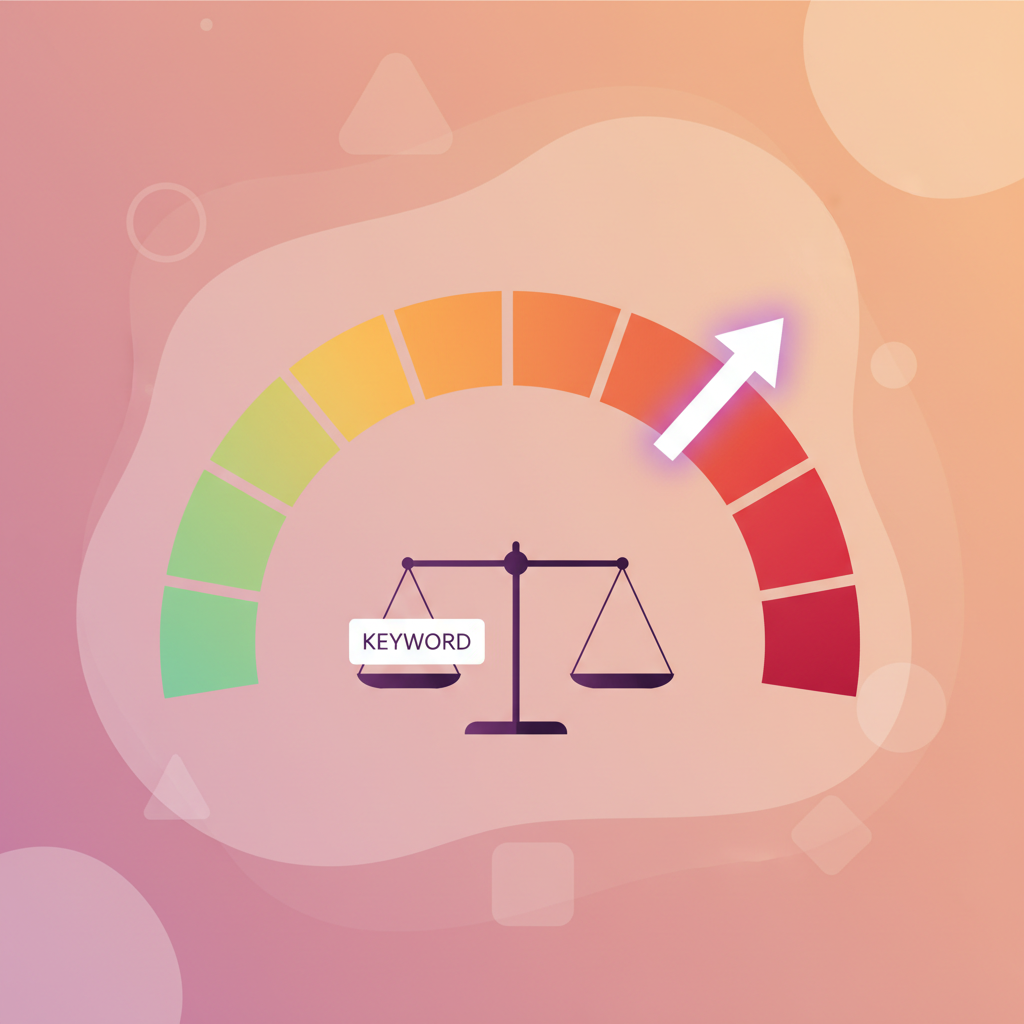
Easy · winnableMediumHard · saturated
What makes a keyword “hard”
A keyword is hard when the pins already ranking for it are strong and numerous — polished designs, big trusted accounts, clear keyword optimisation top to bottom.
It’s easier when the top results are a mix of smaller accounts, mediocre or off-topic pins, and gaps.
Difficulty, in other words, is really a read on the competition already sitting in the results — not some abstract score.
It helps to remember that difficulty is really just a proxy question: “is there room for one more good pin here, or is this space already owned?”
You’re not measuring some abstract score — you’re sizing up whether you can realistically earn a spot in these results.
Keep that plain question in mind and difficulty stops feeling technical; it becomes a quick, practical read on your odds.
How to judge difficulty by hand
You can eyeball it in a couple of minutes.
Search your candidate phrase and study the top row and first screen of results:
- Are the top pins from huge, established brands, or smaller/varied accounts?
- Are they tightly optimised for this exact phrase, or loosely related?
- Do the designs look strong, or is there room for a clearly better pin?
- Is the intent a perfect match, or are results a bit scattered (a gap you can fill)?
Wall-to-wall strong, on-topic pins from big accounts = hard.
A mixed bag with weak or off-topic results = your opening.
It’s a judgement call, but a fast and useful one.

Why long-tail lowers difficulty
The reliable way to drop difficulty without dropping intent is to go longer and more specific.
“Bedroom ideas” is a war zone; “small cozy bedroom ideas for renters” is winnable and often converts better because it’s exact.
Longer phrases almost always have lighter competition — the whole logic behind targeting low-competition keywords and mining autocomplete long-tails.
Never judge difficulty without volume
Difficulty and volume are useless apart — you must read them together.
An easy keyword with no search volume is a dead end (you’ll rank #1 for something nobody types).
A high-volume keyword that’s brutally hard is a wall you’ll never climb.
The gold is the overlap: real demand and beatable competition.
Judging one without the other is how people waste months either ranking for nothing or losing to giants.
So always pair the two checks.
First, does this phrase have enough real demand to be worth it?
Only if yes do you ask the second question: can I realistically outrank what’s already there?
Both “yes” means target it now; a “no” on either means skip or park it.
That two-question filter, run on every candidate, is the entire discipline of smart keyword selection — and it’s why a tool that shows both side by side saves so much time.
Mine the gaps competitors miss
Some of the easiest wins are the neighbours of phrases your competitors already rank for — closely related long-tails they never targeted, with real demand and no strong pin defending them.
Study the accounts winning your niche and note what they didn’t cover; that’s covered in find your competitors’ best keywords.
Those gaps are difficulty on easy mode.
The rule
Ten specific keywords you can rank #1 for beat one giant keyword you’ll never crack. Win the winnable first — those wins build the account trust that eventually makes bigger, harder terms reachable. Difficulty isn’t forever; you climb to it.
There’s also a psychological trap worth naming: the biggest keywords are the most tempting precisely because they feel like the “real” prize.
Ranking for “home decor” sounds so much more impressive than “small rental bedroom decor”.
But impressive-sounding and profitable are different things — the giant term sends you nothing if you’re buried on page five, while the humble long-tail quietly sends real, targeted traffic every week.
Swallow your ego, target the winnable, and let the results — not the vanity of the keyword — decide what’s worth your effort.
The scoreboard that matters is clicks, not how grand the phrase sounds.
Stop guessing difficulty by eye
Eyeballing every phrase is slow and inconsistent, especially across a big list.
Seeing a real demand score next to the actual pins ranking for each phrase — side by side — turns difficulty from a gut feel into a sort-and-pick job.
You instantly spot the phrases where demand is real but the competition is beatable.
That side-by-side view is exactly what PinPinterest is built to give you: real demand plus the ranking pins and a competition read for millions of phrases, so you can filter straight to the winnable ones.
Judge demand and difficulty together, and you stop wasting pins on walls you can’t climb.
Difficulty changes as you grow
Here’s an encouraging truth: keyword difficulty isn’t fixed — it’s relative to you.
A phrase that’s too hard for a brand-new account can become winnable once you’ve built trust, ranked some easier terms, and earned a healthy track record.
So the phrases you skip today aren’t off-limits forever; they’re a second lap.
Win the easy ones first, and the medium ones open up next.
This is why the smart play is to start with the most winnable keywords and climb.
Each ranking pin builds the account and domain trust that makes slightly harder terms reachable, which builds more trust, and so on.
You’re not lowering your ambitions by targeting easy keywords first — you’re building the ladder to the hard ones.
Trust compounds, and difficulty bends as it does.
A fast difficulty scorecard
When you don’t have a tool handy, run this quick mental scorecard on any phrase — each “yes” toward hard nudges it up the difficulty scale:
- Are the top pins mostly big, established brands? (harder)
- Are they tightly optimised for this exact phrase? (harder)
- Do the designs look strong, with no obvious weak spots? (harder)
- Is the intent a perfect, unambiguous match? (harder)
- Is it a short, broad head term rather than a specific long-tail? (harder)
Mostly “no”?
That’s your opening — go make the best pin for it.
Mostly “yes”?
Note it for later and find a longer, more specific cousin you can win now.
Seed topics
Pinterest suggestions
Filtered by real demand
Winning long-tail keywords
Find real-demand keywords you can actually rank for
Pair this with the best Pinterest SEO tools and pin titles that rank.
#pinterest keyword difficulty#keyword competition#keyword research#pinterest seo
More in SEO8 other guides in this categorySee all Mia Bennett is the pen name the PinPinterest team writes under. Our guides share what we learn building a Pinterest analytics tool — no fluff, just what actually moves traffic.