Pinterest Ads vs Organic Reach: Where Should Your Money Go?
Should you pay for Pinterest ads or grow organically? Here’s the honest comparison — cost, speed, longevity — and how to combine both for the best return.
By Mia Bennett · PinPinterest editorial team


This is one of the smartest questions you can ask before spending a cent: do I pay for Pinterest ads, or grow organically?
The answer isn’t “one or the other” — it’s knowing what each is genuinely good at, so your time and money go where they’ll actually pay off.
Let me lay it out honestly, without the ad-platform hype.
The core difference is simple.
Organic reach is you earning distribution by ranking fresh, relevant pins in search — free, slow to start, and it compounds.
Ads are you paying to place a pin in front of people right now — fast, ongoing cost, and it stops the moment you stop paying.
Neither is “better”; they’re different tools.
AdsOrganic
Speed to first click
Ongoing cost
Longevity
Compounds over time
The question to answer before you spend a cent
Before we compare the two, answer one question honestly: what do you actually need right now — speed, or a durable asset?
That single answer decides almost everything.
If you have a launch next week and need eyeballs immediately, no amount of “be patient with organic” helps you.
If you’re building something to run for years, pouring money into ads that stop the second you unplug them is a leaky bucket.
Same platform, opposite tools, chosen by your timeline.
The second question is: is what you’d promote actually ready?
Ads are an amplifier, and amplifying something broken just makes the problem louder and more expensive.
If your pins have weak keywords, or your destination page doesn’t convert, or a pin is quietly flagged, fix that before you spend — otherwise you’re paying Pinterest to send people to a dead end.
Answer those two — what do I need, and is my offer ready — and the ads-versus-organic decision mostly makes itself.
Most people skip them and just start boosting pins on vibes, which is exactly how ad budgets vanish with nothing to show.
So let’s look at what each is genuinely good at.
What organic reach is great at
Organic is the foundation, and for most people it should be the priority.
Because Pinterest is a search engine, a well-optimised pin can rank and drive free clicks for months — even a brand-new account can win.
It compounds: every ranked pin keeps working while you add more on top.
The downside is patience — it takes weeks to build, as I cover in how long Pinterest takes to work.
It’s worth saying plainly: for the vast majority of creators and small businesses, organic should be the foundation and ads the occasional accelerant — not the other way around.
Ads feel productive because money is moving, but spending is not the same as building.
If you only ever ran organic, you could still grow a thriving Pinterest presence for free.
If you only ever ran ads, you’d have nothing the moment the budget stopped.
Keep that hierarchy straight and you’ll make far smarter decisions about where every dollar and hour goes.
What ads are great at
Ads buy you speed and control.
They’re excellent for a product launch, a time-sensitive promotion, or testing which pins and keywords convert before you invest months in them organically.
That last use is underrated: a small ad spend can tell you in days what would take weeks to learn organically.
The catch is that the traffic ends when the budget does — you’re renting reach, not building it.
The honest trade-off
- Need traffic this week? Ads. Building a durable asset? Organic.
- Tiny budget? Organic first — it’s free and compounds.
- Launching or promoting something time-bound? Ads make sense.
- Want to de-risk a big organic push? Test the keywords with a small ad spend first.
The smartest play: use both together
The pros don’t choose — they layer.
Build your organic foundation of fresh, keyword-optimised pins for durable free traffic, then use targeted ads to accelerate launches and test winners.
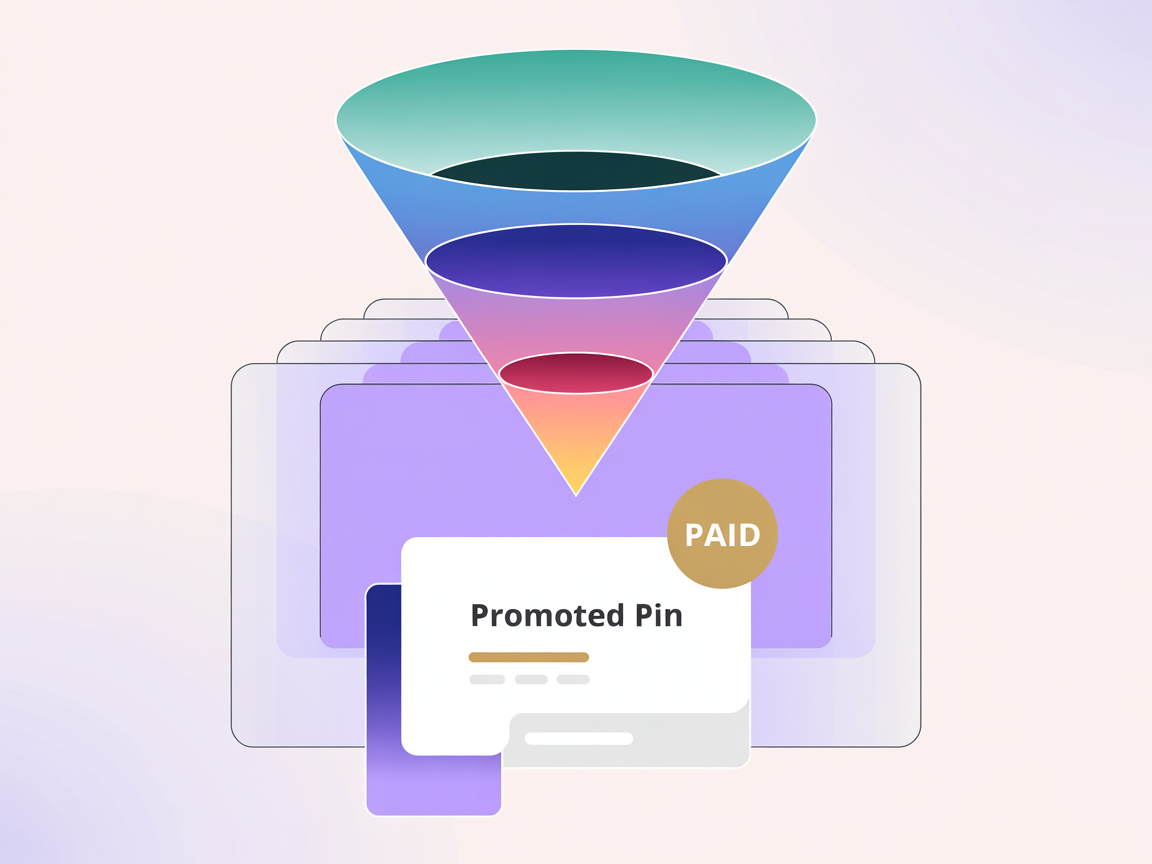
Crucially, ads and organic feed the same funnel: both should point at an offer and, ideally, capture an email so you own the audience either way.
Seen in search & feeds
Clicked through to you
Joined your list
Bought or booked
How to run your first Pinterest ad the smart way
If you do decide to test ads, the golden rule is to promote something that already works.
Don’t invent a brand-new pin for an ad — look at your organic pins, find one that’s already earning saves and clicks, and put budget behind that proven winner.
You’re amplifying momentum, not gambling on an unknown.
This alone separates people who profit from ads from people who just donate money to Pinterest.
- Pick an organic pin that’s already performing — proven design, proven keyword.
- Point it at a page with a clear next step (an offer, a lead magnet, a product).
- Target tightly — specific keywords and interests, not “everyone”.
- Start with a small daily budget you’re comfortable losing while you learn.
- Give it a few days, then judge it on clicks and conversions, not impressions.
That last point trips people up constantly.
An ad can rack up impressions and still be a total waste if nobody clicks through and acts.
Judge every ad by the outcome you actually care about — visits, sign-ups, sales — the same discipline I preach for organic in the metrics that matter.
Budgeting: start tiny, scale winners
You do not need a big budget to start — you need a small one and the patience to read the results.
Begin with an amount that wouldn’t hurt to lose, treat the first week as paid research, and watch which pins and audiences actually convert.
Then do the obvious but rare thing: cut what’s not working and pour more into what is.
Most people do the opposite — they spread budget evenly and keep funding losers out of hope.
The free CPM calculator turns that amount into the impressions and clicks it is likely to buy.
Think of it as buying information first and results second.
Once an ad reliably turns, say, a dollar into more than a dollar of value, scaling it up is just math.
And remember ads are a multiplier, not a foundation — they work best sitting on top of a healthy organic account.
If your organic pins are weak or flagged, fix that first, because amplifying a broken pin only wastes money faster.
Ads rent attention; organic builds an asset
The moment you stop paying, ad traffic stops. The pins you rank organically keep working for months. So use ads to accelerate and test — but never let them become a crutch that lets you neglect the compounding, free foundation underneath.
Whatever you spend, know your numbers
The mistake with ads is spending before you know which pins and keywords convert.
And the mistake with organic is not tracking which pins are climbing.
Both are the same error: flying blind.
Whether the traffic is paid or free, you need to see what’s actually working so you double down instead of guessing.
Don’t pay to boost a broken pin
Never put ad money behind a pin with weak keywords or a hidden health flag — you’ll amplify a dud. Get the organic fundamentals right first: real keywords, clean pin health, a clear offer. Then ads accelerate something that already works.
The through-line is data.
Which keywords convert, which pins have momentum, whether anything’s being throttled — those are the metrics that matter, and native analytics hides most of them.
PinPinterest surfaces the keyword demand, rank and health behind both your organic pins and your ad candidates, so every dollar and hour goes to a proven winner.
When you’re ready to monetise all that traffic, how to make money on Pinterest has the options.
Find the pins worth promoting — before you spend a cent
#pinterest ads#organic reach#pinterest advertising#pinterest strategy
More in Monetization3 other guides in this categorySee all Mia Bennett is the pen name the PinPinterest team writes under. Our guides share what we learn building a Pinterest analytics tool — no fluff, just what actually moves traffic.